

If you’ve ever worked with a client who doesn’t quite meet the full criteria for a diagnosis, but is clearly experiencing distress, you’re not alone. Many CBT clinicians encounter cases that blur the lines between established categories. Perhaps a client presents with traits of a personality disorder without fully meeting diagnostic thresholds. Or they appear to qualify for both generalised anxiety and major depression, yet the issues seem interconnected rather than distinct.
Since 1980, the Diagnostic and Statistical Manual of Mental Disorders (DSM) has been the dominant framework for defining mental illness. Its promise was straightforward: standardising diagnostic criteria would improve consistency between clinicians and lay the groundwork for more rigorous scientific research. But over four decades on, many are asking whether that promise has been fulfilled.
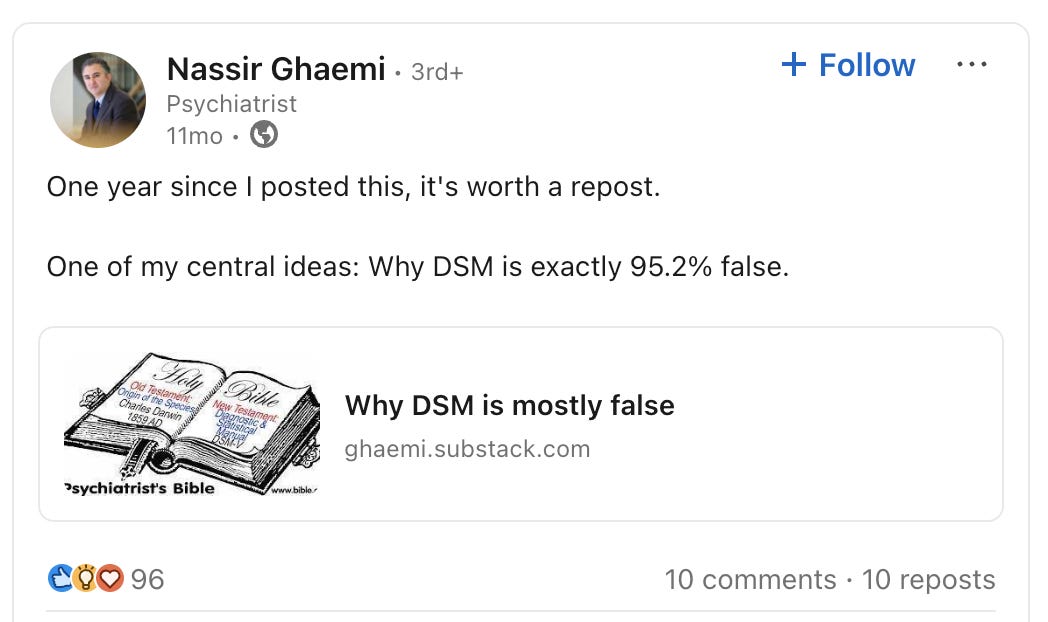
Psychiatrist Nassir Ghaemi is among the critics calling for reform, and he’s not alone. He argues that the DSM prioritised reliability (agreement between clinicians) over validity (accurately reflecting underlying conditions), and in doing so, inadvertently stalled meaningful progress in psychiatric research and practice (Ghaemi, 2018).

What the DSM Got Right and What It Missed
When DSM-III launched in 1980, it revolutionised psychiatry. Gone were the vague, Freudian descriptions. In came checklist-style criteria aimed at improving consistency across clinicians. It worked, at least in part. Therapists could now agree whether someone “had” or “didn’t have” a disorder.
But this emphasis on standardisation came at a cost.
The criteria were largely based on consensus, not science, and once agreement was achieved, the field stopped evolving. Ghaemi argues that the profession treated reliability as the destination, not the starting point (Ghaemi, 2013). As a result, diagnostic categories remained rigid, even as research began to show that many conditions overlap, interact, or defy the neat boundaries imposed by the manual.
The cracks became harder to ignore by the time DSM-5 was introduced. By the early 2010s, even major research institutions were voicing concerns. The U.S. National Institute of Mental Health (NIMH) publicly distanced itself from the DSM, calling for new approaches to understanding mental illness.
For clinicians, particularly in CBT, this raised an uncomfortable question: if even researchers doubt the system’s categories, how useful are they in guiding real-world practice?
When Labels Multiply but Clarity Shrinks
After DSM-III, each new edition brought more diagnostic categories, but not necessarily more diagnostic clarity. What began as an effort to standardise became what Ghaemi calls nosologomania: an explosion of new labels, many based more on expert opinion than robust scientific evidence (Ghaemi, 2013).
Clinicians began seeing clients with multiple overlapping diagnoses. Was it comorbidity, or were we just slicing up the same problem into artificial parts? For instance, symptoms of irritability, sleep disturbance, and poor concentration can appear in both generalised anxiety and major depression. Yet DSM’s checklist approach treats these as two separate conditions, when they may stem from a shared underlying mechanism (Van Praag, 1996).
Even more troubling, some changes were driven less by evidence and more by political compromise within the profession. New categories were added or removed based on consensus meetings, not experimental findings. In practice, this left many CBT clinicians treating clusters of symptoms that didn’t quite fit but still caused real distress.
A Medical Model or Just a Medical Metaphor?
DSM claims to follow the “medical model,” but in reality, it behaves quite differently from how medical diagnosis actually works. In most areas of medicine, diagnosis follows a hierarchical, rule-out process: if a patient has a cough and fever, doctors rule out pneumonia before diagnosing a common cold.
By contrast, DSM uses a flat checklist approach: if you meet five out of nine criteria, you get the diagnosis, even if those symptoms overlap with another disorder. There’s no clear “diagnostic hierarchy” to help clinicians distinguish primary vs secondary causes.
Take panic attacks, for example. In a hierarchical model, a clinician might first ask why the panic is happening: exploring whether it’s a symptom of complex trauma, PTSD, bipolar disorder, or another underlying process.
By contrast, the DSM’s categorical approach is descriptive rather than hierarchical. It allows multiple diagnoses if symptom criteria are met. As a result, a client presenting with panic symptoms might receive three separate diagnoses: panic disorder, complex PTSD, and bipolar disorder, even if the panic clearly stems from mood dysregulation or trauma responses.
This can inflate comorbidity rates and risk misdirecting treatment. For CBT clinicians, it might mean focusing on panic management techniques when the real therapeutic target lies elsewhere, such as emotional regulation or trauma processing.
Science Without Symptoms?
In 2013, the U.S. NIMH took a decisive step. Citing concerns with the scientific limitations of the DSM, it announced it would no longer fund research based solely on DSM-defined categories (Cuthbert & Insel, 2013). In its place, NIMH introduced the Research Domain Criteria (RDoC): a new framework grounded in neuroscience, behaviour, and genetics.
For researchers, this marked a promising shift toward biologically informed models of mental health. But for many clinicians, it felt disconnected from day-to-day practice.
How do you translate brain circuitry into meaningful interventions when your client is describing panic, guilt, or intrusive thoughts?
As psychiatrist Ghaemi puts it, the DSM is clinical but unscientific, while RDoC is scientific but unclinical (2018). What’s still missing is a model that bridges the gap, one that’s evidence-based but also grounded in clinical reality.
Building a Better System: Hierarchies and Dimensional Models
One response to this challenge comes from Krueger et al. (2018), who proposed a dimensional, hierarchical nosology, a model that maps symptoms onto broader spectra rather than discrete categories.
Originally developed for personality traits, the idea has expanded to cover a range of mental health conditions.
Ghaemi (2018) takes this further. He proposes a symptom-density hierarchy, placing severe, biologically rooted difficulties like bipolar disorder and schizophrenia at the top, and narrower, less impairing conditions like anxiety or specific phobias at the bottom.
In this model:
• Mood and psychotic disorders are treated as foundational.
• Personality disorders are seen as downstream effects.
• Comorbidity is reinterpreted as mislabelled symptom overlap.
For CBT clinicians, this matters. It could reshape how we prioritise treatment targets, and how we conceptualise complex cases.
But… What Does This Mean for Clinicians?
The takeaway? No system is perfect, but some are more useful than others.
Ghaemi’s (2018) call isn’t just to reject DSM or RDoC. It’s to rethink how we diagnose: to move from checklists to logic, from flat categories to layered understanding, and from consensus to science.
For CBT clinicians, this doesn’t mean abandoning what works. It means staying flexible. Diagnoses can guide, but they shouldn’t blind us to patterns, complexity, and clinical nuance.
The DSM won’t disappear overnight. But if it continues to dominate unchallenged, psychiatry risks staying stuck.
Should CBT clinicians quietly accept its limits, or push for something better? Tell us how you navigate diagnostic complexity in your practice or research!
Author: Jennifer Gomez Llanos
I very much enjoyed this read. It’s great to see Ghaemi’s work becoming more widespread. His book on the history - and failings - of the biopsychosocial model is also an insightful read.
I have very mixed feelings about DSM. As a CBT therapist I have found the diagnoses incredibly useful in guiding treatment decisions. Regardless of whether social anxiety disorder or insomnia disorder are valid constructs, the treatments I select look very different for each (e.g. video feedback would not be helpful to the latter whilst sleep restriction would be unhelpful to the former).
I think there is nuance to Ghaemi’s argument, as he’s also very critical of the anti psychiatry movement who contest that no psychiatric diagnosis is valid. He would argue that some are - I think around a dozen or so - like schizophrenia, bipolar disorder, panic disorder, OCD, and PTSD (which he likens to a psychological injury).
He suggests DSM has also caused practitioners to focus on assessing for symptoms (via a checklist) to make a diagnosis, rather than looking for other diagnostic validators like genetics/family history, course of illness, and treatment response.
In fairness to the DSM, it was never intended to be reified in the way it has been. Indeed, in the introduction - which basically no one reads - it suggests that it should be used as a clinical tool, alongside clinical judgement. I think its use in America to bill insurance companies is partly responsible for this.
Finally, the DSM has at least stood up to some diagnostic ‘fads’, especially as complex PTSD has been rejected time and again, unlike ICD which has included it seemingly for convenience, despite the incredible shakiness of the whole construct.
Thanks for writing and sharing your comments. Thinking of workable solutions is very tricky. Historically, CBT aligned itself with psychiatry as an opportunity; they followed the funding. However, this needn't continue. CBT has a solid enough foundation and evidence base without the need to hitch itself to an unscientific system. For example, the core processes and procedures of CBT guide us well enough and psychology could take the lead on this. We needn't wait for psychiatry to tell us how.