

My brother told me this week that everyone junior to him in his company (he’s a coder) has been made redundant as AI can do the job. I ached as I knew this was happening, and yet I equally felt relatively shielded from these direct impacts as a therapist.. so far. But it made me think about the broader society trend, more people than ever are asking what if my career disappears? what’s the point in mastering a skill that will be redundant? If my work becomes obsolete (or has become)… what does that make me?
There are whole reddit threads of people whose job was lost to AI.
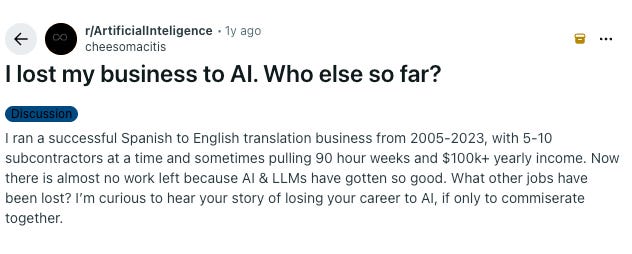
Financial activities and information sector payrolls fell by 28,000 jobs a month on average in 2026.1 Bloomberg tied the decline to accelerating AI adoption. The job displacement is real, and it is happening. Part of me hates even acknowledging this because I am partly in denial, and secondly, writing about such a rapid change in our society increases my own anxiety. Time to tolerate uncertainty.

But this article isn’t about whether AI is good, bad or something else, it’s about right now. And as argued by the authors in the paper I’m about to discuss, therapists need to be involved in active advocacy for the mental health impacts of this major society shift of job displacement - particularly now, during the transition phase to a society none of us quite know yet.
Enter ‘Artificial Intelligence Replacement Dysfunction’ Disorder
A recent paper (2025) published in Cureus2 proposes a new clinical construct called Artificial Intelligence Replacement Dysfunction (AIRD) to describe the psychological distress people may experience when faced with the threat - or reality - of AI replacing their work. The authors argue that therapists should begin preparing for presentations characterised by anxiety, insomnia, depression, demoralisation, identity confusion and fears surrounding professional obsolescence.
Reading it, I found myself agreeing with almost everything they described in presentation, but equally it was relatable to everyone. I imagined if everything I’d gone through in the last 10 years or so to get to this point in my career meant nothing anymore. All the training, education, clinical hours, marketing, business building… only to be told the job no longer exists. I was filled with existential dread, and I am sure I only felt a raindrop of what people who are going through this feel.
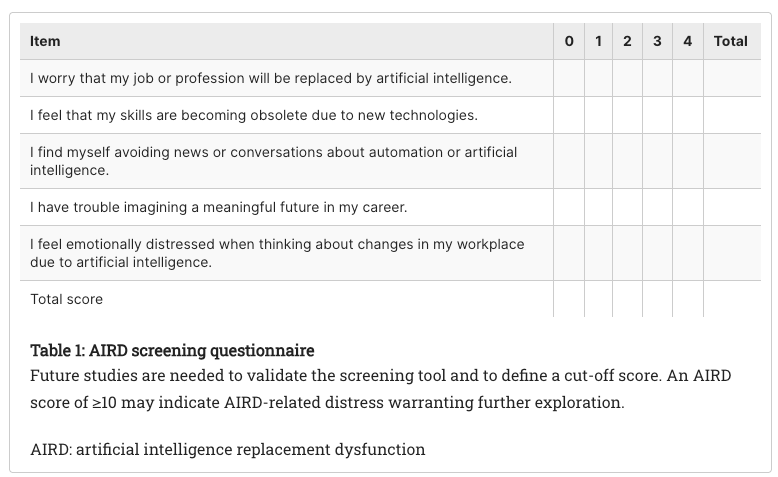
The authors propose a screening to help establish levels of AIRD as separate from general measures of depression and anxiety. Treatment may include a mix of evidence based techniques from CBT and ACT. I can see why ACT would be very helpful. There is no current treatment protocol.
Is This Dysfunction?
Whilst I agree with recognising this as a uniquely distinct difficulty, separate to our other diagnostic categories, the term dysfunction felt a bit… off.
Many of our diagnoses are in context. If somebody genuinely believes their profession will disappear and they will have no income... if they’re watching colleagues being replaced.. if graduate jobs are nearly non existent with student loans hanging over your head... a significant response doesn’t seem particularly dysfunctional. It seems as human as being anxious during wartime. I’m not sure we’d call that war dysfunction.
Equally, I can see how the symptoms of the mental response (withdrawal, depressive behaviours, obsessive thinking, rumination, no sleep etc.) will lead to further dysfunction. I know the authors are not using the term to be invalidating and simply classifying mental and behavioural responses, but I just wish we had a better term. Diagnosis will also help us move to a place of coherent treatment plans and perhaps even insurance claims, but what that looks like currently is uncertain.
Tell me in the comments - what would you call this difficulty if you had to give it a diagnostic name? Or should it even have a separate term?
Perhaps This Is Really About Identity
The part of the paper I found most compelling wasn’t actually the anxiety.
It was the identity confusion. The authors describe people questioning their relevance, purpose and future employability.
Many of my clients care deeply about their jobs and profession… not only is it their source of income but also a source of pride and achievement. A source of identity. I think many of us as therapists can relate that this career is not one you just do because you can. It often speaks to a core sense of identity. Truly if I wasn’t a therapist, I don’t know what I’d do. On my most stressful days I imagine running a cat cafe.

If AI begins removing or radically changing those identities, perhaps what we’re witnessing isn’t primarily occupational stress.
Perhaps it’s significant identity disruption - the same in the aftermath of trauma.
Identity disruption has always been psychologically significant.
The Even Bigger Question
What struck me most wasn’t whether AIRD should become a diagnosis, but it was whether mental health professionals are prepared for a future where large numbers of psychologically healthy people begin presenting with existential questions that aren’t irrational.
Historically, technological revolutions have tended to create new jobs alongside destroying others.
But AI has become the first technological shift where respected economists, industry leaders and researchers openly disagree about whether that historical pattern will continue.
Some forecast substantial displacement, while others expect adaptation and new job creation.
That uncertainty matters psychologically.
Because humans don’t just need income. We need purpose. Competence. To feel useful (or am I talking about myself? Not sure).
And perhaps most fundamentally...
We need an answer to the question:
“Who am I if the thing that gave my life structure and meaning no longer needs me?
Perhaps society will catch up. Tech leaders including Musk have argued for a universal basic income to protect from the job displacement AI will cause3. Perhaps there will be new ways to find meaning, such as through hobbies and community, because of all the time freed up. Indeed, Musk actually suggested a universal high income (UHI) world, where the cost of living is low due to all the excess goods AI produces, and we can all live in prosperity without working significantly. Perhaps I can open my cat cafe and be a therapist.
But we’re far away from these ideas right now, which leaves our clients (and us) right in the transition zone.
What do you think? I think we need to be talking about this more openly in the therapy community and would love to hear your thoughts.
https://finance.yahoo.com/technology/ai/articles/finance-tech-lose-28-000-133000801.html?guccounter=1&guce_referrer=aHR0cHM6Ly93d3cuZ29vZ2xlLmNvbS8&guce_referrer_sig=AQAAAFp2-W2B3WpJP3SY-AizHtwbzx1pWyechU_SrOOqLjqRjLEcaIE2V0-0e3K8hyAu2gEgQ9KS0NB7lbJMHsmfuRg2ZJ3WxQSiUXK1rQNhD_Aj0bIZv4bM0YNBnhp-rwUXrXxOsuou0fAR8nP2_KGc8S3Ckj6hV997elb4WKFIulQC
https://pmc.ncbi.nlm.nih.gov/articles/PMC12459875/
https://taxproject.org/ubi-and-ai/