

As therapists, coaches and clinicians, we already know that bullying features commonly in the histories of many people who later develop social anxiety and other self-worth difficulties1.
Experiences of rejection, humiliation, exclusion and ridicule can shape the way someone comes to understand themselves in relation to other people, even more so during childhood and adolescence.
But one form of bullying I see time and time and again in clients, that appears to be less spoken about in wider society, is bullying by a teacher.
As a result, I set out to understand why this may happen, firstly to aid clients in understanding why this may have happened to them, and secondly, to aid how I approach the impact as a result.
I have written a summary below, as well as embedded the youtube video I made exploring this. I hope you enjoy, and I’d love to know your thoughts!!
Sophia :-)
Commonly in the therapy room an adult presents with beliefs such as I’m bad, I’m too much, I don’t fit in, there’s something wrong with me, and sometimes somewhere in their history sits a teacher who repeatedly singled them out, mocked them, embarrassed them publicly, treated them as a problem or seemed to take a particular dislike to them.
Before going further to discuss this, it seems apt to define what teacher bullying actually is.
Twemlow et al2 defined teacher bullying as a teacher using their power to punish, manipulate or disparage a student beyond what would constitute reasonable disciplinary practice.
But as a result, an astute observer left a comment on my youtube video about teacher bullying asking what really counts as a result:
I went to school with a kid that claimed a teacher bullied them when they just werent doing their school work properly, constantly having the parents leave work to deal with this students panic attacks over detentions . Like this student wouldnt do their homework and they claimed the teacher was too hard on them when all the other students had no issue with the teacher and completed their school work on time. Like whats the line of a teacher holding a student accountable for their homework and a teacher being an outright bully .....
And that’s a great question.
I think the truth is we have no consensus, and nearly everyone may answer differently. Could the line even differ student to student depending on that students needs and individuality? Perhaps. Is it the manner of how things are delivered even if they themselves are reasonable? I certainly have an inner sense of what I feel is beyond reasonable procedure, and could list things included in that, but I am sure some would disagree.
Do let me know in the comments what you think!
In the therapy room, something is often clear that is was beyond reasonable teaching procedure because of the impact on the person sitting in front of me. The difficulty, perhaps compared to other forms of bullying, is that these experiences can produce a particularly stubborn form of self-blame.
One belief I have repeatedly come up against is some version of: “There must have been something about me, otherwise why would a teacher have treated me like that compared to everyone else?”.
Many people are capable of recognising that humiliating a child is inappropriate in the abstract, but when it comes to their own experience, uncertainty creeps back in. Maybe I really was annoying. Maybe I was difficult. Maybe they could see something in me that I couldn’t. Why would an adult behave that way towards a child for no reason? There must be a reason and that reason is me.
I can see how this happens. I remember once feeling that a teacher picked on me a lot at school and told my parents. My parents then complained to the school. 30 years or so later I can’t remember if the teacher really did pick on me, or if I was being overly sensitive.
But I do remember one class after my parents had been in contact, the teacher then saying out-loud 'If you feel like I’m picking on you, then tell me, don’t go running to your parents like SOME people in this class’ whilst looking at me.
I don’t particularly remember that as teacher bullying or anything out of the ordinary, but of course I was absolutely humiliated in the moment and couldn’t wait to move up to the next year to be rid of her. Yet using Twemlow’s definition, or even if I heard someone else explain that as an experience, I would consider it unreasonable behaviour from an adult towards a child.
Which made me really reflect… there’s something about a teacher bullying that often seems to encode itself in the child brain and memory as somewhat reasonable, even if it wasn’t. I hadn’t even thought of that experience until I was researching this, and that experience is no-where close to the bullying I often hear about which is significantly more repeated and emotionally harmful.
And this is what I often encounter in therapy with clients.
A key problem from the client’s perspective is that there is a missing explanation. If the teacher’s behaviour wasn’t evidence that something was wrong with them, particularly when they weren’t doing it to any other student, then what was going on? It’s hard to let go of a belief when you have no information to suggest otherwise.
Even thinking about a responsibility pie chart in CBT or an interweave in EMDR, what other information does the client have to shift responsibility? There’s often a gaping hole in which there is no helpful information.
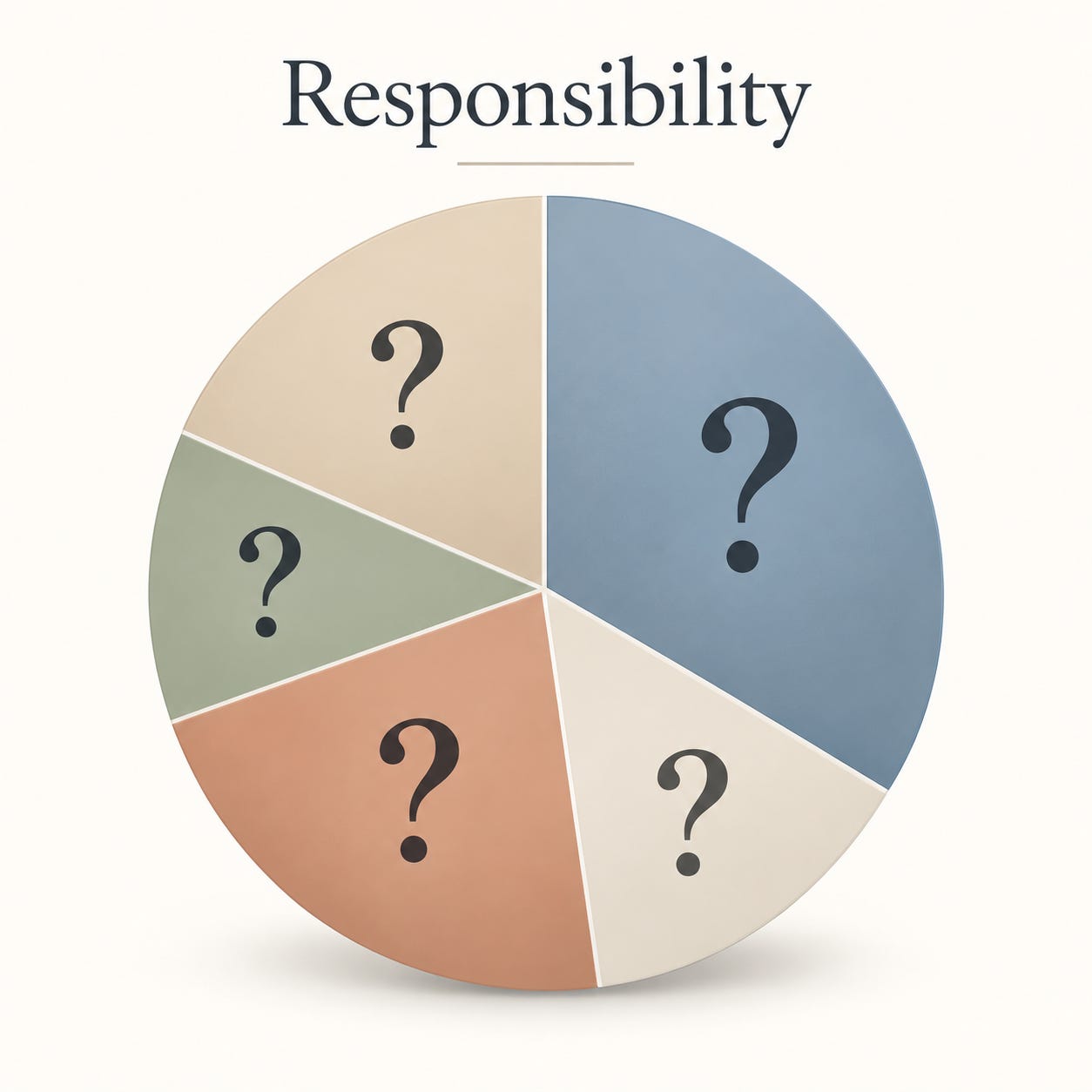
So, I started looking more closely at what the literature on teacher bullying actually suggests about why this might happen. For some clients, understanding that there are other plausible and documented explanations for an adult’s behaviour can be surprisingly freeing.
It helps shift the teacher from the position of objective authority who had somehow discovered the truth about them, to another human being whose behaviour was also being shaped by personality, stress, history, biases, insecurity and power. One whose pattern repeats so often and frequently across the world that there is a literature base about it.
The clients experience may have felt unique in context, but it wasn’t, and that can be both normalising for the client, as well as terrifying as to what it says about our educational systems.
Two Types of Teacher Bullies
One important distinction in the research was that there is not one single teacher bully, but two.
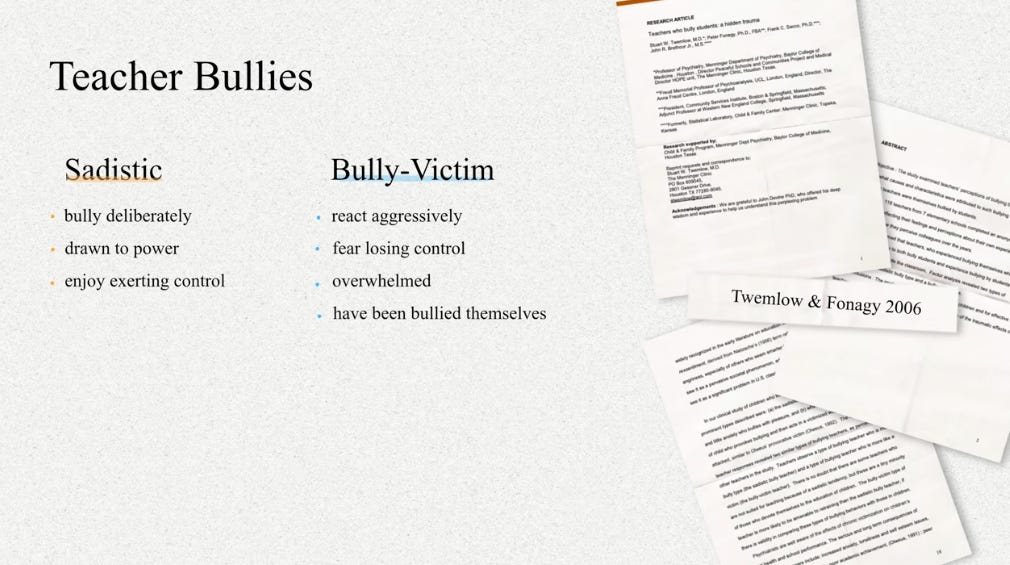
Twemlow3 and colleagues described different patterns, including what they called a sadistic bully and a bully-victim.
The Sadistic Bully
These are teachers who bully deliberately. They are often (not always) individuals drawn to positions of authority because they enjoy exerting control. They may even target high-achieving, creative, or envied students to assert dominance.
The Bully-Victim
These are teachers that when faced with classroom stress, can react aggressively out of a fear of losing control.
They often feel overwhelmed by student behaviour.
Often these teachers commonly have even been bullied themselves.
When when Twemlow4 and his researchers asked other teachers what they thought about these teachers, they suggested they are more like a victim.. Hence the term bully-victim.
A range of possibilities
Clinically, I think that distinction is important. The work is not necessarily to tell a client, your teacher was projecting, as though we can confidently know the internal world of someone we have never met. Nor is it likely helpful to replace one rigid explanation with another flattering one, such as she was jealous of you or he was threatened because you were so intelligent. We usually don’t know.
The more useful therapeutic task may be to expand the range of possible explanations until the client’s original certainty that it is something to do with them begins to loosen.
Instead of they treated me badly because there was something wrong with me, we might arrive at: there were many things that could have been happening in that adult, and I cannot treat their reaction as objective evidence about who I was.
This can become particularly important when the child genuinely was ‘difficult’ in some way (I put difficult in quote marks because I think what is considered difficult is in the context of a school system that normalises and reproduces one way of studying and being). However perhaps the client as a child may have been loud, impulsive, oppositional, inattentive, argumentative or disruptive. If so, many clients use this as retroactive proof that the treatment was justified: I probably was hard work.
Here I think it helps to separate the child’s behaviour from the adult’s response.
A child can be challenging to teach and an adult can still respond abusively. Those two facts do not cancel one another out. Being disruptive may explain why some discipline was required; it does not automatically explain bullying, humiliation, cruelty or repeated targeting. We can name the behaviour without taking responsibility for an adult’s misuse of power.
Indeed, other research suggests that marginalised, neurodiverse, struggling or vulnerable students are more likely to be targets for bullying by teachers as a result. This creates a vicious cycle where the child is already struggling, perhaps is challenging in some way to a teacher as a result, and receives bullying, which only escalates their struggle at school.
There is also a social element to formulation that can easily be missed.
Belonging is a fundamental human motivation5, and for children school is one of the central social environments outside of the home in which they learn about status, relationships, safety and acceptance. If the adult who governs that environment repeatedly positions a child as undesirable, the experience may become about much more than fear of the teacher. It can become a threat to the child’s membership of the group itself.
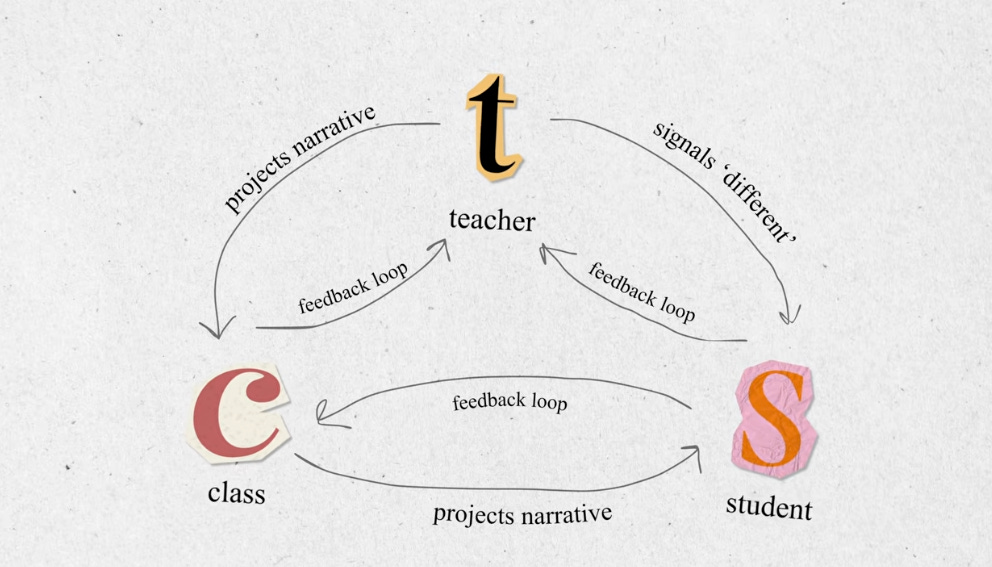
This may be particularly relevant when we are working with social and performance anxiety.
A client who is terrified of speaking in meetings, being watched, getting an answer wrong or appearing incompetent may not simply have learned that “mistakes are bad”. Their learning history may have been much more interpersonal: visibility gave somebody powerful an opportunity to humiliate me.
If a teacher laughed when they got something wrong, criticised them publicly or encouraged a classroom atmosphere in which others joined in, it makes sense that speaking becomes associated not just with error but with sudden loss of social standing and group membership.
When teacher bullying appears in someone’s history, I therefore want to understand not only what happened, but what the child concluded from it. Not just about themselves, but about authority and group membership.
The later therapeutic work can then involve giving the adult mind access to a distinction that the child mind could not easily make: authority is not the same thing as accuracy. The teacher may have been able to punish them, grade them, embarrass them and influence how other people treated them. That power made the teacher’s opinion consequential. It did not necessarily make the opinion true, valid or worthy of belief.
For me, with clients the most useful shift is away from the question, “What was wrong with me that made them treat me like that?” and towards a broader question: “What was (or could have been) happening in the adult who had all the power?”
That is also where my original exploration of teacher bullying eventually landed. Children often do not have the psychological distance to conclude, this adult has a problem. When someone with authority treats them badly, it can feel much more logical to conclude that there is something wrong with them.
We may never know exactly what was happening in that teacher. Therapy does not require us to know. What matters I think is helping the client recognise that the adult’s behaviour was generated by a psychological system too. Their teacher was not a neutral instrument measuring the child’s worth. They were another human being, with their own history, reactions, vulnerabilities, biases and capacity to misuse power both on purpose and accidentally. This information I have found is central to loosening the grip of their impact.
Tell me your thoughts! Do you see teacher bullying come up a lot? Did you experience it? How would you even define it?
McCabe, R. E., Antony, M. M., Summerfeldt, L. J., Liss, A., & Swinson, R. P. (2003). Preliminary examination of the relationship between anxiety disorders in adults and self-reported history of teasing or bullying experiences. Cognitive Behaviour Therapy, 32(4), 187–193. https://doi.org/10.1080/1650607031000...
Reflective teaching
Twemlow, S. W., Fonagy, P., Sacco, F. C., & Brethour, J. R., Jr. (2006). Teachers who bully students: A hidden trauma. International Journal of Social Psychiatry, 52(3), 187–198. https://doi.org/10.1177/0020764006067234
Twemlow, S. W., Fonagy, P., Sacco, F. C., & Brethour, J. R., Jr. (2006). Teachers who bully students: A hidden trauma. International Journal of Social Psychiatry, 52(3), 187–198. https://doi.org/10.1177/0020764006067234
Twemlow, S. W., & Fonagy, P. (2006). Transforming violent social systems into non-violent mentalizing systems: An experiment in schools. In J. G. Allen & P. Fonagy (Eds.), The handbook of mentalization-based treatment (pp. 289–306). John Wiley & Sons.
https://pmc.ncbi.nlm.nih.gov/articles/PMC7312524/
Baumeister, R. F., & Leary, M. R. (1995). The need to belong: Desire for interpersonal attachments as a fundamental human motivation. Psychological Bulletin, 117(3), 497–529. https://doi.org/10.1037/0033-2909.117.3.497