

Hello,
I know I’ve been a little quieter on Between Sessions over the last few months, thank you for being here.
The honest reason is that my clinical work has grown significantly. Between 1:1 work, groups, and now workshops, I found myself pretty stretched (in the best way), and this space became more neglected than I’d like.
That pause gave me time to reflect on the future of Between Sessions. I didn’t want to stop, but I also couldn’t maintain what it was. I’ve also held off (aka avoided) making changes out of fear of annoying the 1000+ people who have subscribed to what the substack currently is. So, I guess this is an exposure experiment for me, too!
For those who don’t know, my clinical focus is on social and performance anxiety, imposter syndrome, and the psychology of being seen - the quieter, often hidden forms of social fear.
This Substack originally held a broad mix of research and clinical skills. But over time, I’ve realised that the broader my focus became, the less depth I was able to offer.
So Between Sessions is shifting, not dramatically, but intentionally.
Going forward, the writing here will be more closely aligned with my clinical work and research interests, including:
social psychology
social and performance anxiety
imposter syndrome
self-esteem, visibility, and belonging
There will be less general “what’s new in research” coverage, and more depth on these specific themes. I’ll also update on conferences and anything I attend.
If this direction isn’t for you, I completely understand - and you can unsubscribe at any time.
If you stay, I hope this more focused direction brings greater clarity, depth, and usefulness.
Thank you for being here - I’m glad to be writing again. I hope you enjoy this article on working with public speaking anxiety.
Sophia :-)
This article accompanies the video above and reflects my clinical experience working extensively with social, performance, and visibility-based anxiety. It is not formal CPD. Please take what is useful, critique what isn’t, and adapt it to your own model, supervision, and context. Free resources are at the bottom.
Public speaking anxiety is one of the most common - and most misunderstood -presentations I see.
It often gets folded into “social anxiety” in a way that leaves both therapists and clients confused about what is actually driving the fear, and therefore how to work with it effectively.
This article breaks down how I conceptualise public speaking anxiety in practice, including:
the overlap and distinction between social anxiety and performance anxiety
why some clients don’t identify with the term social anxiety at all
how fear of anxiety itself can sit alongside fear of judgment
why environment, power, status, and identity matter far more than we often account for
how I adapt formulation and intervention depending on what is maintaining the problem
Social Anxiety vs Performance Anxiety
At its core, social anxiety is about fear of negative evaluation - but that fear can be organised around different threats.
Clinically, I find it helpful to distinguish (loosely) between:
Interpersonal social anxiety
This is primarily about acceptance and belonging.
Examples:
fear of saying the wrong thing at a party
holding back in conversations to avoid appearing awkward
concern about being rejected, excluded, or disliked
The central threat often sounds like: “If I am seen as I really am, I won’t be accepted.”
Performance-based anxiety
This is more about competence and status.
Examples:
presentations
speeches
being observed while performing a role
The central threat often sounds like: “If I appear anxious or make a mistake, I’ll be seen as incompetent.”
This is why some people can be socially confident, warm, and relaxed, yet completely unravel when they have to speak publicly.
And why others experience every social interaction as a performance, where competence is constantly being evaluated.
These aren’t rigid categories.
A presentation to close colleagues, for example, often activates both competence and belonging threats.
Why Some Clients Reject the Label “Social Anxiety”
Many people with public speaking anxiety do not resonate with the public narrative of social anxiety - which is often framed as:
shyness
avoidance of social contact
generalised interpersonal fear
The DSM-5 does acknowledge performance situations within social anxiety (particularly in adolescents), but sometimes diagnostically naming the problem is often far less important than collaboratively understanding it.
I generally use whatever language feels most accurate and helpful for the client- while remaining curious about which threat system is being activated.
Two Processes, Not One: External Threat and Internal Threat
This is where public speaking anxiety often becomes clinically complex.
For some clients, the anxiety is driven purely by the external social threat:
being judged
being evaluated
being seen as incompetent
For others, there is a secondary internal process running alongside it.
The external trigger
The situation itself:
standing up to speak
being visible
being evaluated by an audience
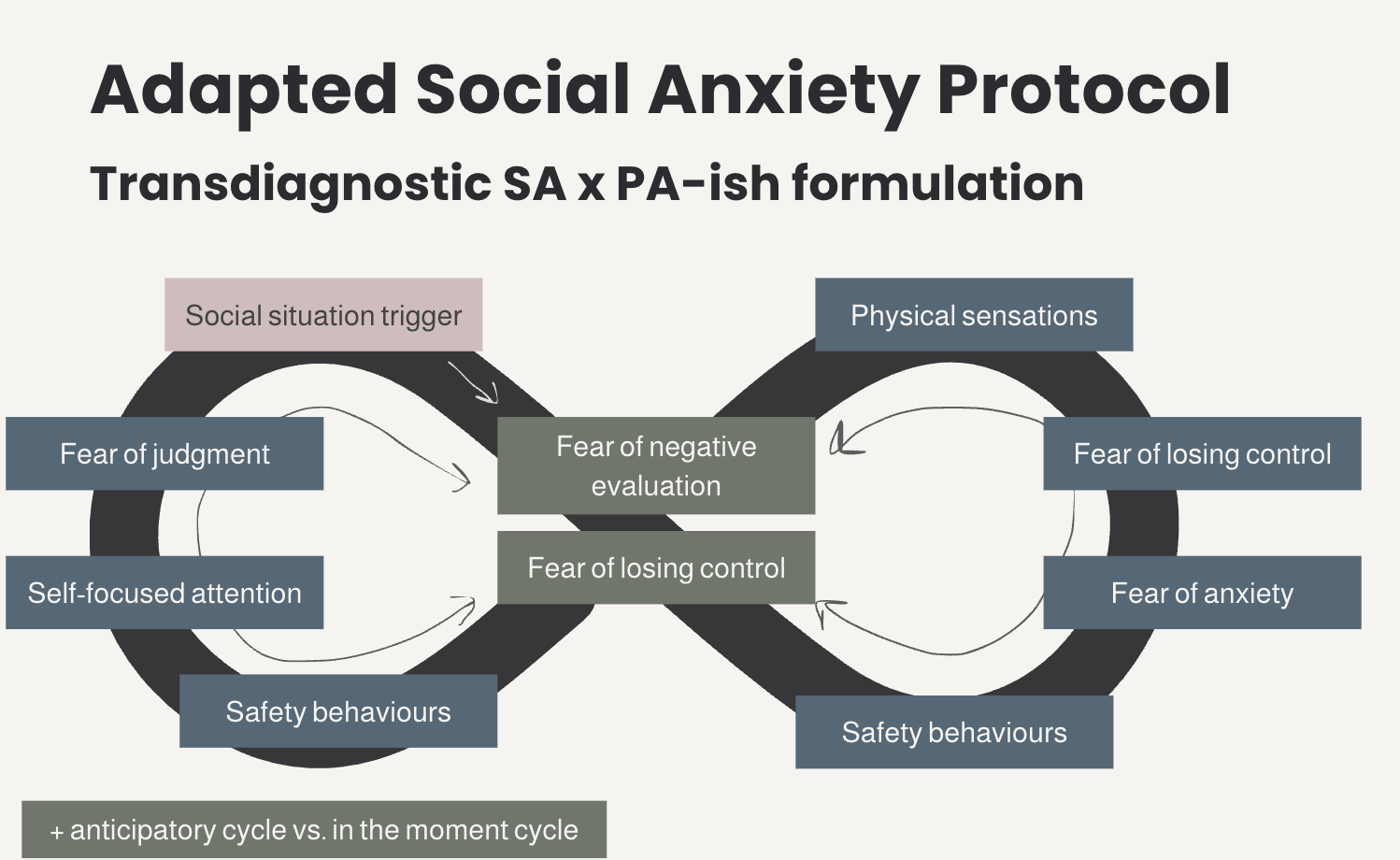
This maps neatly onto the classic Clark & Wells social anxiety model:
fear of negative evaluation
self-focused attention
safety behaviours
distorted self-imagery
The internal trigger: fear of anxiety itself
For many clients, particularly high-functioning ones, the dominant fear becomes:
“What if my anxiety gets out of control - and people see it?”
This can look similar to panic-attack maintenance, even when the person does not identify as having panic attacks.
The feared outcome is often:
freezing
mind going blank
visible shaking
dry mouth
losing control in front of others
having to stop because overwhelmed with anxiety
The problem is not just anxiety - it’s anxiety about anxiety, especially when visibility and consequence are high.
I have many clients come through who have tried CBT for public speaking already, and their previous treatment focused on de-sensitisation of physical sensations, essentially, the panic attack protocol.
Sometimes it helps. But the problem is, often these clients aren’t afraid of anxiety sensations generally (unlike in panic disorder, where generally any anxiety sensation could escalate into a possible panic attack).
They’re only afraid of the sensations in this environment, with these people. Desensitisation sometimes doesn’t help because they’re not afraid of the sensation itself, and some do not believe they’ll have a panic attack. They’re afraid more of the loss of control over anxiety being perceived in a social context.
Work here tends to focus on not trying to control anxiety, and undoing the nuanced safety behaviours that have built up around managing anxiety itself.
Why Environment Matters More Than We Think
A key clinical mistake I see (and made in my early days) is focusing too narrowly on the act of public speaking and not the the environment in which it occurs.
Many clients don’t have a problem with speaking.
They have a problem with speaking there, to those people, under those conditions.
Important questions to hold in mind (not necessarily all asked directly):
Why this audience?
What power dynamics are present?
What would it mean if this group judged them negatively?
Do they already feel “below”, different, or exposed in this environment?
Are there identity factors (gender, class, race, age, background) increasing visibility or vulnerability?
For some clients, the feared consequence is concrete:
career damage
loss of opportunity
financial risk
For others, it is relational:
exposure as an imposter
humiliation
loss of belonging
And sometimes, humiliation is the endpoint.
Status, Hierarchy, and Social Rank
This is where social rank theory becomes particularly useful.
Social rank theory suggests that humans are biologically wired to monitor status, hierarchy, and relative position within groups. Our brains evolved to track whether we are above, equal to, or below others because social rank historically affected safety, access to resources, and belonging.
In public speaking and performance anxiety, the feared outcome is often not just making a mistake, but can also be a status drop:
losing credibility
being exposed as “not good enough to be here”
falling in others’ eyes
Importantly, both low perceived rank (“I must prove myself”) and high perceived rank (“I can’t afford to fall”) can intensify anxiety. The brain responds not to objective status, but to felt rank in that moment.
Clinically, social rank theory helps us understand why anxiety escalates in hierarchical or evaluative environments - and why the fear often feels visceral, disproportionate, and hard to talk oneself out of.
Crucially, some environments are genuinely evaluative or discriminatory.
Therapy should not minimise this reality - but help clients differentiate between realistic risk and anxiety amplification.
Social Identity and Belonging Threat
Social identity theory adds another layer.
When a group represents:
professional identity
cultural belonging
social class / culture
values or meaning
Rejection or judgment from that group can feel like a threat to who the person is, not just how they performed.
For many people, work becomes their primary “tribe” - especially so if other sources of belonging are limited.
Risking judgment there can feel existential rather than situational.
Formulation: Keeping It Simple Without Missing What Matters
In practice, I usually:
start with a standard social anxiety formulation
layer in fear-of-fear only if it is clinically relevant
distinguish between:
anticipatory anxiety
in-the-moment anxiety
post-event processing
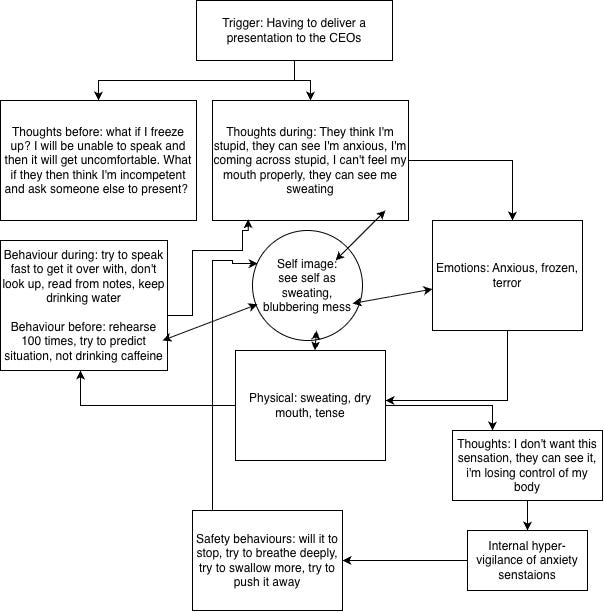
I rarely draw complex dual-loop diagrams with clients unless it genuinely helps.
This level of complexity is often more useful for the therapist’s understanding than for the client’s.
Exposure When Opportunities Are Limited
Public speaking anxiety often involves infrequent but high-stakes events, which makes exposure work challenging.
Options may include:
imaginal exposure for one-off events
in-session audience simulations
creative public experiments targeting visibility and/or performance
VR-based exposure tools
carefully structured real-world experiments
Groups like Toastmasters can be helpful - but can also inadvertently reinforce new safety behaviours if not held in mind before attending.
In my experience, feeling safe being seen in the environment must come before performance optimisation. That’s what I do in my group.
Trauma, Memory, and Relational Safety
For some clients, public speaking anxiety is exacerbated by:
past humiliating experiences
bullying
relational trauma
chronic social threat
Imagery re-scripting or EMDR can be powerful where a specific memory is driving the fear.
It’s also common for public speaking anxiety to sit on top of broader patterns of:
social hyper-vigilance
panic disorder
significant relational trauma
low self esteem
You don’t always need to go “there” - but it’s important to recognise when public speaking anxiety is a symptom, not the whole picture.
Free Resources
Evolution of the social brain & public speaking PDF

Maintenance Cycles PDF
Safety Behaviour Guide
List of Common Safety Behaviours
List of Common Physical Symptoms
I hope you found this helpful and I’d love to know your thoughts! How do you find public speaking anxiety, both as a client or practitioner?
Sophia
This was a great find, thank you for sharing. The introduction of the Social Rank theory is especially apt and novel in the formulation.
This couldn’t have come at a better moment. Thank you for posting.