

Self-consciousness comes up throughout clinical work: social anxiety, performance anxiety, panic attacks, body dysmorphia and more. New research may help us understand self-conscious emotions, and perhaps some aspects of social anxiety, differently.
Most therapists working with social anxiety are familiar with self-focused attention. It sits at the centre of social anxiety models as a key maintaining factor in both anxiety and distorted self-image.
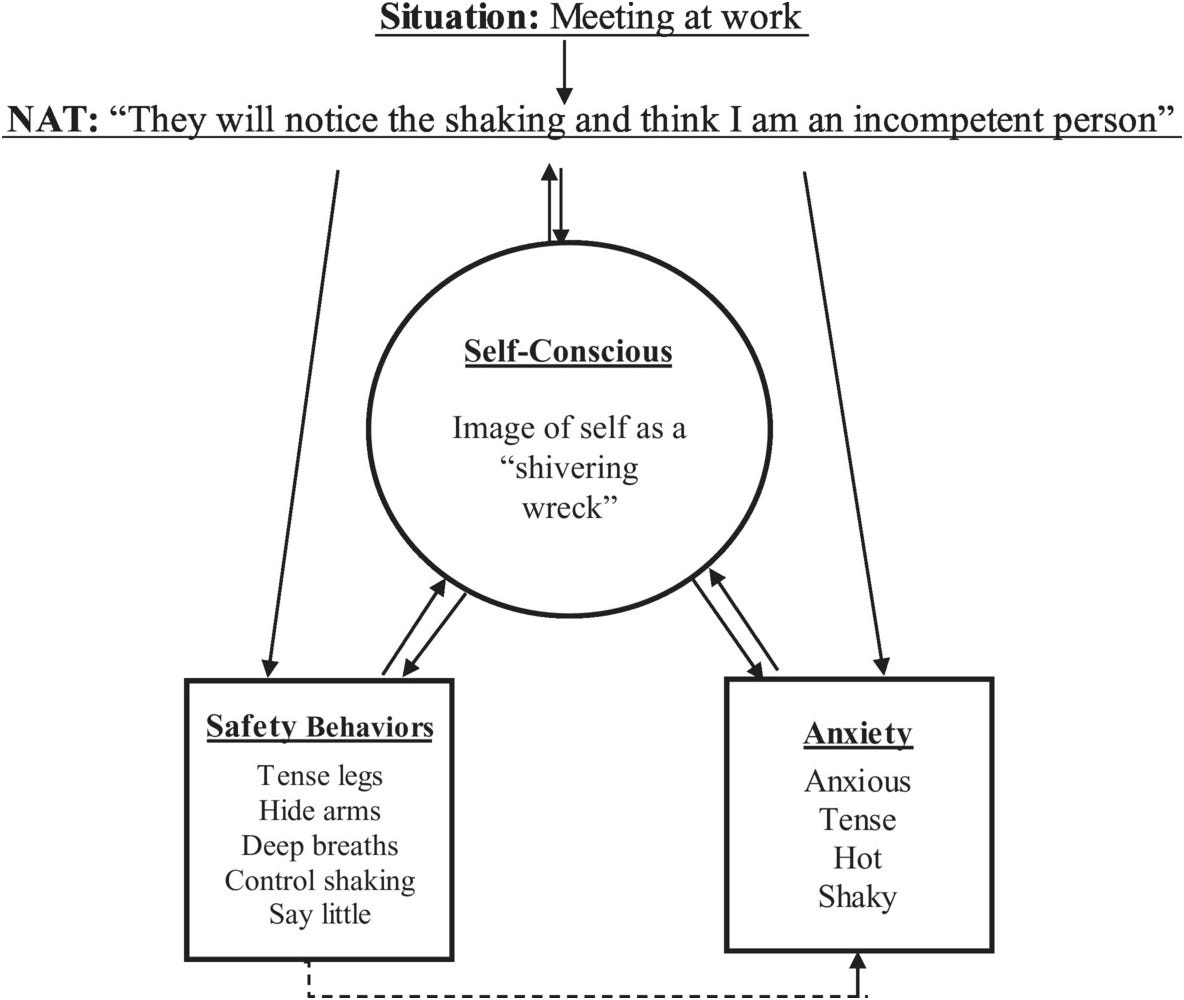
As in the cycle above, when people become socially anxious, their attention turns inward. They begin monitoring themselves.
However, a recent paper by Tracy and Ibasco (2026)1 published in the journal of personality and social psychology made me wonder whether there is another question worth asking:
Why does attention turn inward in the first place? (aside from the typical NAT/predictions).
Why do we feel self-conscious? What is it exactly?
Prominent research on self-consciousness suggests that people feel self-conscious emotions when they evaluate their self-caused, identity-relevant behaviour as a success or failure (Tracy & Robins, 20042).
For example, I evaluate whether my self-caused behaviour of speaking up in a group, relevant to my identity of being a good person, was a success or failure. If I decide it was a failure, self-consciousness follows.
Tracy and Ibasco argue differently. They suggest people feel self-conscious emotions when they evaluate their self-caused, identity-relevant behaviour as discrepant from expectations, not simply as a success or failure.

Across studies, when participants exceeded expectations, they felt greater pride compared to when they met or fell below expectations; when participants fell below expectations, they felt greater shame or guilt. These findings provide evidence for a new understanding of the cognitive mechanisms of self-conscious emotions.
When we bring this back to clinical work, the question becomes: are you self-conscious because you stumbled over your words, or are you self-conscious because you expected yourself not to?
I have to say in my own example above, I wasn’t self conscious because I didn’t recognise her and made a social faux pas. I was self conscious because I do expect myself to be a considerate and kind person, and in that moment, I definitely felt discrepancy from that. I felt rude and careless.

Traditionally, we partly conceptualise self-consciousness as arising because attention has become excessively self-focused.
But this research raises another possibility.
What if self-focused attention is sometimes a consequence rather than a cause?
Somebody attends a meeting. They expect themselves to feel confident. They expect themselves to belong. They expect themselves to know what to say. Then they notice anxiety. Suddenly something feels wrong. Not necessarily because anxiety itself is dangerous.
But because it violates an expectation.
“I shouldn’t be nervous.”
“I should be able to do this.”
“Why am I reacting like this?”
Attention then turns inward.
Monitoring begins.
Analysis begins.
Self-consciousness increases.
In this sequence, the expectation violation comes first.
The self-focused attention follows.
Many of us already know this line of thinking from seeing these types of beliefs emerge in formulations for social anxiety, as well as in rules and assumptions work across depression, anxiety, and low self-esteem.
However, I have never quite linked it to social anxiety and self-consciousness in the way that this research may suggest. To a degree, this research made me reflect that perhaps deeper psychoeducation on the mechanisms of self consciousness could be beneficial.
In addition, rules and assumptions can operate at an embedded level we may not identify without a longitudinal formulation, something not always done for social anxiety.
Expectations about anxiety itself may also be important. If somebody believes they should not experience anxiety, then the experience of anxiety becomes an expectation violation in its own right, potentially increasing self-consciousness.
An expectation-based perspective offers one possible explanation as to why the self-consciousness arises in the first place. That is not to say attentional focus is not important, but that it may only be one part of the picture.
Thoughts for future clinical work
I don’t think this research invalidates existing cognitive models of social anxiety, nor is it trying to. Self-focused attention remains one of the most consistently supported maintaining factors we have.
However, this paper made me wonder whether we sometimes focus more on where attention goes than on what triggered it to move there.
This could lead to slightly different conversations.
Rather than only asking:
“What were you paying attention to?”
We might also ask:
“What did you expect from yourself in that moment?”
“What felt surprising about your ability in that moment?”
“What expectation had just been violated?” (love this one personally!)
For some clients, the answer may reveal an important layer underneath the self-consciousness itself.
One that is less about attention and more about identity.
What do you think?
Does this fit with what you see clinically?
And do you think expectation violations deserve a larger role in our formulations of social anxiety and shame?
In addition, I am reminded of a worksheet I made for clients on social perfectionism, which I attach for free in case it is of any use for anyone! It applies a rules and assumptions framework to social and performance anxiety.

Tracy, J. L., & Ibasco, G. C. (2026). The unexpected importance of expectations in self-conscious emotions. Journal of Personality and Social Psychology, 131(1), 45–74. https://doi.org/10.1037/pspa0000486
Putting the self into self-conscious emotions: A theoretical model. Jessica L. Tracy & Richard W. Robins · Psychological Inquiry 15 (2):103-125 (2004)