

If your clients (and you… and me…) avoid small talk or casual chats because they think they’ll be boring, they may be missing out on meaningful connections and enjoyment. That’s what a new study1 which caught my attention found.
The research question focused on understanding how enjoyable are conversations about boring topics? (my immediate thought as someone who finds it hard to sit still, let alone have a boring convo? not interesting).
But this sounded important to me for three reasons:
Nearly all people I work with worry about coming across boring
Nearly everyone I know has not attended something due to the prediction of it being boring (me included)
We know people are lonely - and is the part of the puzzle?

What Did They Find Exactly?
The paper2 examined whether people accurately predict how enjoyable conversations about boring topics will be.
Before conversing about a boring topic with a conversational partner, participants were asked to rate how likely they would:
enjoy the conversation
find it interesting
want to do it again
They then rated them again after having the boring topic.
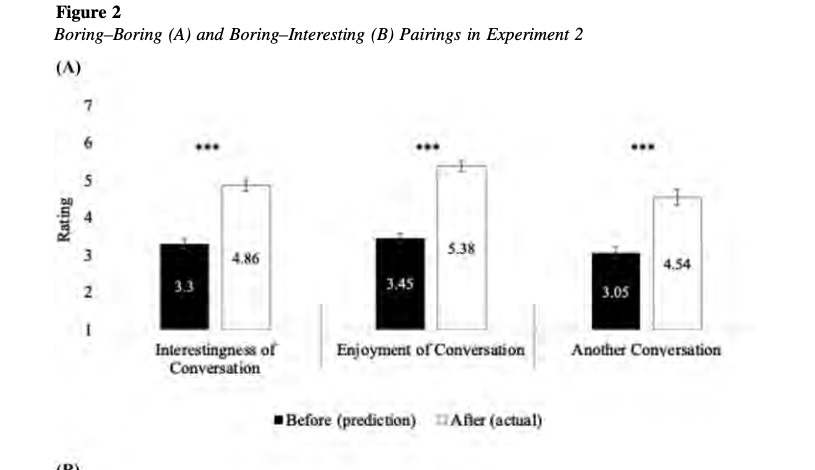
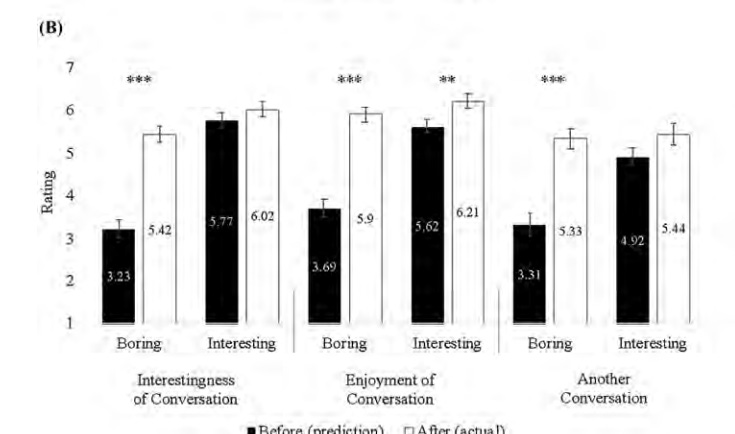
Across nine studies involving over 1,800 participants, people consistently underestimated:
how interesting conversations about boring topics would be
how enjoyable they would be
how much they would want another conversation afterwards
The findings were replicated in:
conversations with strangers
conversations with friends
self-generated topics, and
researcher-assigned topics
One of the findings I found most interesting was that the effect remained even when both participants considered the topic boring. In other words, conversations did not become enjoyable simply because one enthusiastic person carried the interaction.
What was happening? The influence of static and dynamic factors
In CBT terms we’re always evaluating whether predictions are true or not. But this paper also proposes a difference between static and dynamic factors in how we predict social situations, something I hadn’t heard of before.
Static elements of a social situation are things we know before an experience begins.
Examples might include:
the topic of conversation
who will be there
where the event is
whether we know anybody
the meeting agenda
They are factual, and therefore easy to base predictions on.
Dynamic elements are different. They emerge during the experience itself.
Examples might include:
engagement
humour
rapport
spontaneity
connection
The researchers argue that people over-rely on static information when making predictions because it is immediately available.
Actual enjoyment is often determined by dynamic factors that can only emerge through participation.
Put simply: people predict conversations based on the topic or situation (static) but experience conversations through engagement (dynamic).
This distinction struck me because it feels highly relevant to social anxiety, depression (and pretty much life in general).
It also made me think about those who worry about coming across boring when having to present or talk about something objectively boring. In this way, the findings may suggest that the topic is less important than the way in which it is delivered. I’ve certainly been on health and safety trainings for the 1000th time that were awfully boring in content (static) but enjoyable in delivery (dynamic).
Using This Research Clinically: Thoughts and Questions
Reading the paper, I found myself thinking that it is almost further evidence as to the utility of behavioural experiments (even though this was not the intent of the research). After any behavioural experiment, we’re looking to squeeze learning, particularly around anxiety vs reality. This paper gave me further thought to evaluate what can be taken from the learning of static v dynamic factors?
It also made me wonder whether we should also spend more time exploring how clients understand the static v dynamic elements of a conversation. Do both elements contain fear? One more than the other? Do we avoid due to static? Catastrophise the dynamic? Do predictions based on static feel more true?
This also strikes me as one of those pieces of research that could actually be shared with clients, in order to normalise how many people think and feel this way. If you ever wanted to share it with them, but not share this article, here’s a news link.
What do you think?
https://www.apa.org/pubs/journals/releases/psp-pspi0000521.pdf
Please note this research is not clinical research but from the journal of social and interpersonal psychology. It is not a RCT.